






On Thursday, October 29, 2026, millions of married women across northern and western India will rise before dawn, eat a pre-fast meal, and spend the day without food or water. In the evening they will gather in their finest clothes, wait for the moon to rise, and break the fast with a sip of water from their husbands’ hands. This is Karwa Chauth, one of the most visually striking and emotionally resonant festivals in the Hindu calendar.
When Karwa Chauth Falls
Karwa Chauth is observed on the fourth day (Chaturthi) of the dark fortnight, or Krishna Paksha, in the Hindu month of Kartik, according to the Purnimanta calendar followed in North India. It usually falls nine days before Diwali, and in 2026 that places it on October 29. Because the festival is tied to moonrise, the exact time to break the fast differs from city to city, so families check local panchang listings or newspapers for it.
The name combines two words. “Karwa” (or “Karva”) means a small earthen pot with a spout, and “Chauth” means the fourth day of the lunar fortnight. The earthen pot is central to the rituals, as it holds the water offered to the moon and is exchanged as a symbolic gift.
The Origins of Karwa Chauth
No single account explains how Karwa Chauth began. Like many Indian festivals, it grew out of several legends, agricultural customs, and social traditions. Here are the most widely told.
The Legend of Queen Veeravati
The most popular story is told during the evening prayers. Veeravati, the only sister of seven brothers, was married and returned to her parents’ home for her first Karwa Chauth. She kept the fast, but as the day wore on, hunger and thirst overcame her. Her loving brothers could not bear to see her suffer. They created a false moon by placing a mirror, or a lit lamp seen through a tree, so that she would believe the moon had risen. Veeravati broke her fast, and almost immediately she received news that her husband, the king, had died.
Heartbroken, she wept and prayed. The goddess Parvati (in some versions, a heavenly spirit) appeared, explained that her fast had been broken prematurely, and told her to observe Karwa Chauth again with complete devotion. Veeravati did so, and her husband was restored to life. The tale underlines why the fast must be completed correctly, and why women wait patiently for the real moon.
The Story of Karva
Another legend tells of a devoted wife named Karva. Her husband was bathing in a river when a crocodile seized his leg. Karva bound the crocodile with a cotton thread through the power of her devotion, then went to Yama, the god of death, demanding that the crocodile be sent to hell and her husband spared. When Yama hesitated, she threatened to curse him. Impressed and slightly afraid, Yama agreed, and Karva’s husband lived a long life. The festival bears her name in remembrance of her courage and faith.
Savitri and Satyavan
Many families also recall the story of Savitri, who followed Yama when he came to take her husband Satyavan’s life. Her determination and wisdom so impressed him that he returned Satyavan to her. Although this story is more closely tied to the Vat Savitri fast, it is often told alongside Karwa Chauth as an example of a wife’s perseverance.
Draupadi and the Mahabharata
According to a tradition linked to the Mahabharata, Draupadi once sought Krishna’s advice when Arjuna was away on the Nilgiri hills and the Pandavas were facing difficulties. Krishna reminded her that Goddess Parvati had observed a similar fast for Shiva, and he advised her to do the same. Draupadi kept the Karwa Chauth fast, and the Pandavas overcame their troubles.
Agricultural and Social Roots
Historians and folklorists offer more practical explanations. The festival falls at the start of the wheat-sowing season, and large earthen pots were traditionally used to store grain. Prayers for a good harvest may have blended with prayers for family wellbeing.
Another theory is that the festival began as a bond of friendship. In many regions, girls married into distant villages and lived among strangers. The custom of “Karwa Dharam Behen” or “Karwa Dharam Saheli” allowed a bride to adopt another woman as her lifelong friend or god-sister, a bond that lasted until death. The two exchanged gifts and shared the fast. Some also link the festival to the wartime absence of soldiers, when women prayed for their husbands’ safe return from battle.
How Karwa Chauth Is Celebrated
Sargi: The Pre-Dawn Meal
The day begins before sunrise with sargi, a meal traditionally sent by the mother-in-law to her daughter-in-law. It typically includes fruit, dried fruit and nuts, sweets, mathri, and sometimes a savoury dish, along with a coconut and festive clothes. Sargi is meant to give the fasting woman strength for the day, and it is a sign of affection between the two women. The meal is eaten before sunrise.
The Fast
After sargi, most women observe a nirjala fast, taking neither food nor water until moonrise. Some health-conscious families allow fruit, milk, or water, especially for women who are pregnant, elderly, or unwell, and many doctors and family elders now encourage this flexibility. The day is spent in light household activity, devotion, and conversation. Women often gather to exchange stories, sing songs, and decorate their hands with intricate henna designs the evening before or that afternoon.
Dressing for the Occasion
Dressing up is a major part of the day. Women wear red, maroon, or other bright colours, often a bridal lehenga, saree, or salwar suit, with bangles, a bindi, sindoor, a mangalsutra, and jewellery. These adornments, known as solah shringar (sixteen forms of beautification), are associated with a married woman’s auspiciousness. In the days before Karwa Chauth, markets across North India fill with bangles, henna artists, and decorated pooja thalis.
The Evening Puja
In the late afternoon or evening, women gather in homes, courtyards, or temples for the puja. They sit in a circle with decorated thalis containing a lamp, roli, rice, sweets, and a karwa filled with water. The Karwa Chauth katha, one of the legends above, is narrated by an elder woman while the group listens. Between verses, the women pass their thalis to one another in a circle, a ritual known as “pheri,” while singing devotional songs. Prayers are offered to Goddess Parvati, Lord Shiva, Lord Ganesha, and Lord Kartikeya, and the moon.
Moonrise and Breaking the Fast
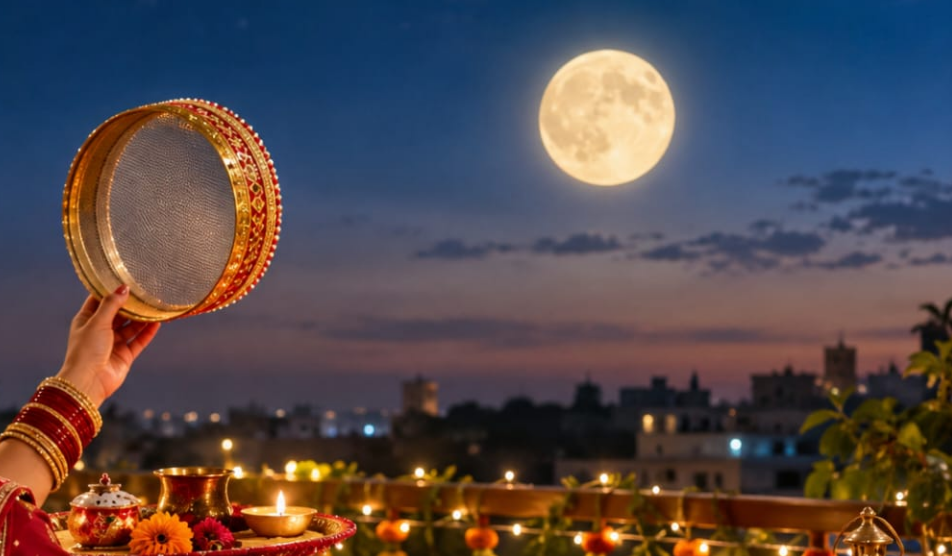
The climax of the festival is moonrise. Women go to a terrace or courtyard and look at the moon, often through a sieve or chhalni with a lamp placed behind it. They then turn the sieve toward their husband’s face. They offer water to the moon, pray for their husband’s long life, and seek blessings. The husband then gives his wife the first sip of water and the first bite of food, which ends her fast. A family meal follows, often including puri, halwa, and other favourite dishes.
Gifts and Family Bonds
Husbands often give gifts such as jewellery, sarees, or flowers, and mothers-in-law and parents may also give presents. The festival strengthens family ties, as married women often visit their natal home or exchange gifts with relatives.
Karwa Chauth in Modern Times
Karwa Chauth has grown beyond its traditional boundaries. Popular films and television serials have given it a romantic image, and it is now observed by many families outside Punjab, Haryana, Rajasthan, Uttar Pradesh, Delhi, Himachal Pradesh, and Madhya Pradesh, including Indian communities abroad.
Interpretations have also shifted. Many couples now treat the day as an expression of mutual love, and a growing number of husbands fast alongside their wives. Some unmarried women fast for a partner they hope to marry, and in some families the fast is a shared celebration rather than an obligation. At the same time, critics argue that fasting for a husband’s longevity reinforces patriarchal expectations, and some women choose not to observe the fast at all. Many people see the festival as a personal choice, a way to honour family tradition and the bond of marriage.